

2026 Chevy Trax vs. 2026 Hyundai Kona: Which Subcompact SUV Wins for Inland Empire Drivers?
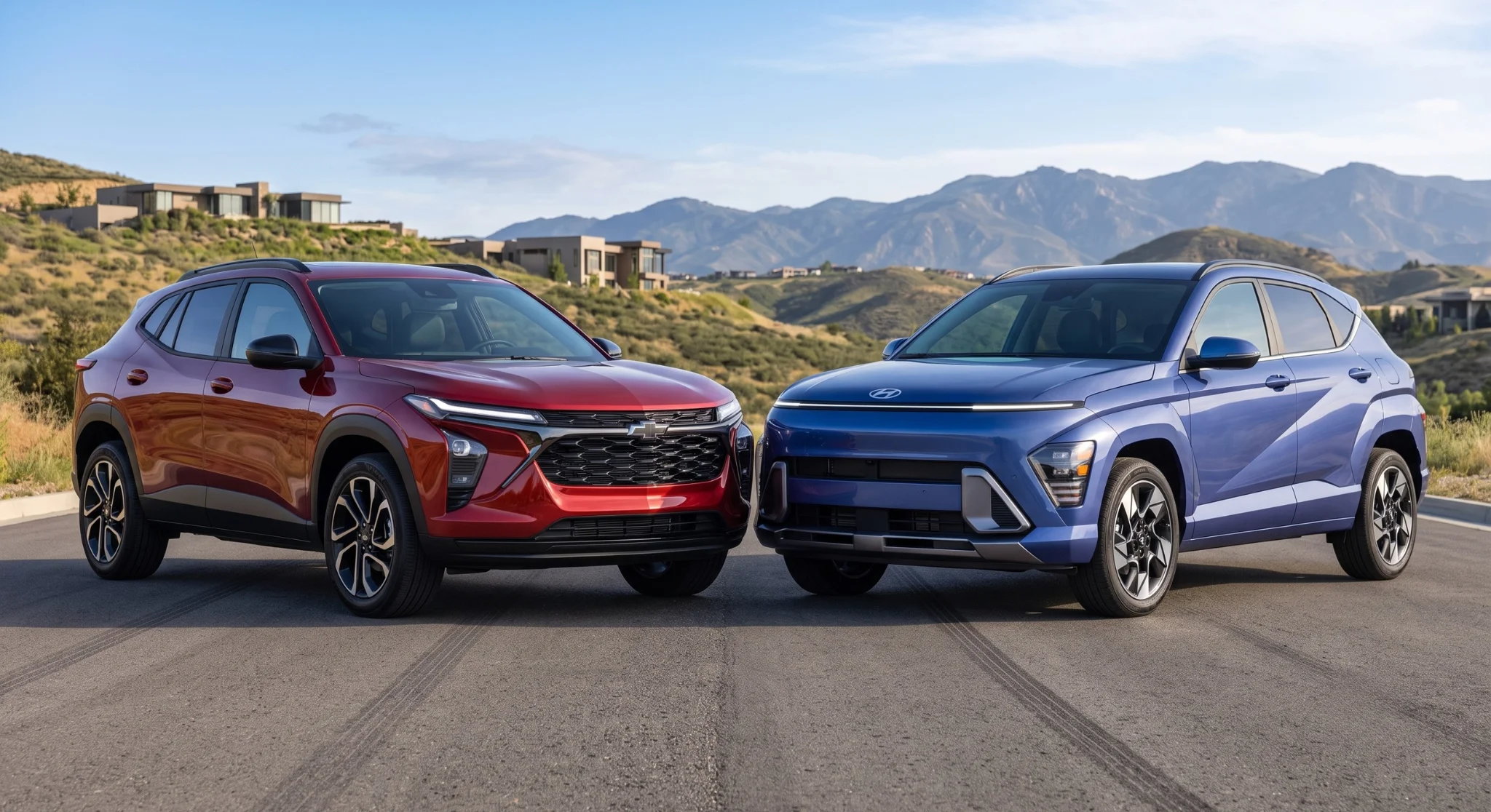
The subcompact crossover segment is crowded, and two of its most cross-shopped names sit at very different price points. This head-to-head puts the 2026 Chevrolet Trax against the 2026 Hyundai Kona across price, powertrain, space, technology, safety, and warranty — with verified figures for both — so you can decide which one fits your driveway and your budget.
Why Inland Empire Families Cross-Shop the Trax and Kona
Many shoppers at Riverside Chevrolet are moving into new stages of family life — daily school drop-offs, weekend errands, and commutes toward Ontario and the surrounding logistics hubs. In master-planned Eastvale neighborhoods near spots like Harada Heritage Park, a small SUV needs to be a versatile daily tool without a midsize footprint or a midsize price.
The valley floor of the Inland Empire is largely flat, which makes all-wheel drive more of a preference than a necessity for most drivers here — keeping efficient front-wheel-drive configurations firmly in play. The Kona leans premium and feature-dense; the Trax leans spacious and value-first. Here is where each one earns its keep.
Pricing: Which Delivers More for the Money?
On price, the contrast is immediate and it holds at every rung of the ladder — the Trax undercuts the Kona from base trim to top trim.
2026 Chevrolet Trax — Starting MSRP by Trim
| Trim | Starting MSRP | What Stands Out |
|---|---|---|
| LS | $23,495 | 8-inch touchscreen, wireless Apple CarPlay and Android Auto, 17-inch wheels, Chevy Safety Assist |
| 1RS | $24,995 | RS sport styling, 18-inch wheels, heated front seats and heated steering wheel |
| LT | $24,995 | 11-inch touchscreen, 8-inch digital gauge cluster, 6-speaker audio, heated mirrors |
| 2RS | $27,195 | 19-inch wheels, 8-way power driver’s seat, synthetic leather, available blind-spot monitoring and adaptive cruise |
| ACTIV | $27,195 | Rugged styling, same technology and available safety as the 2RS |
2026 Hyundai Kona — Starting MSRP by Trim
| Trim | Starting MSRP | What Stands Out |
|---|---|---|
| SE | $27,100 | 12.3-inch touchscreen, wireless Apple CarPlay and Android Auto, full SmartSense, 17-inch wheels |
| SEL Sport | $28,425 | 18-inch wheels, heated front seats, wireless charging, dual-zone climate |
| SEL Premium | $30,025 | 1.6-liter turbo engine, 19-inch wheels, power driver’s seat, 12.3-inch digital cluster |
| Limited | $34,250 | Leather, ventilated seats, Bose 8-speaker audio, 360-degree camera, power liftgate |
A base Trax LS starts roughly $3,600 below a base Kona SE on MSRP, and a fully equipped Trax ACTIV still lands below a mid-tier Kona SEL Premium. For commuters running Interstate 15 or SR-60, that gap translates directly into lower monthly payments while still driving a brand-new, warrantied crossover.
Manufacturer’s Suggested Retail Price (MSRP) for new vehicles includes manufacturer and distributor options and delivery, process and handling fees, which may be subject to change at any time. MSRP excludes taxes, title, license and dealer installed options, accessories, fees and charges. MSRP is not the dealer advertised price. Dealer price will vary. The dealer sets the final price.
Powertrain & EPA-Estimated Fuel Efficiency
The two take different approaches under the hood. The Trax runs one turbocharged engine across every trim; the Kona splits between a base non-turbo four-cylinder and an available turbo four on its upper trims.
| Spec | 2026 Chevy Trax | 2026 Hyundai Kona |
|---|---|---|
| Engine | 1.2L turbo 3-cylinder (all trims) | 2.0L 4-cylinder (SE / SEL Sport); 1.6L turbo 4-cylinder (SEL Premium / Limited) |
| Horsepower | 137 hp | 147 hp; 190 hp (turbo) |
| Torque | 162 lb-ft | 132 lb-ft; 195 lb-ft (turbo) |
| Transmission | 6-speed automatic | IVT (CVT); 8-speed automatic (turbo) |
| Drivetrain | Front-wheel drive only | Front-wheel drive standard; all-wheel drive available |
| EPA-Estimated MPG (FWD) | 28 city / 32 hwy / 30 combined | 29 / 34 / 31 (2.0L); 26 / 31 / 28 (1.6L turbo) |
The honest read: the Kona is the more powerful car, especially in turbo form (190 hp) — that is its lane. The Trax counters with more low-end torque than the base Kona (162 vs. 132 lb-ft), which makes it feel relaxed and responsive in the stop-and-go driving most Inland Empire commuters actually do. On efficiency they are close: the base Kona’s EPA-estimated 31 mpg combined edges the Trax’s 30, while the Kona’s turbo trims fall to an EPA-estimated 28 (FWD) or 26 (AWD) — below the Trax’s consistent EPA-estimated 30 across the board.
EPA-estimated fuel economy figures are for comparison purposes only. Your actual mileage will vary depending on driving conditions, how you drive and maintain your vehicle, battery age/condition, and other factors.
Space, Cargo & Comfort
Both seat five. Where they differ is how they use the space.
| Measure | 2026 Chevy Trax | 2026 Hyundai Kona |
|---|---|---|
| Overall length | Longer (about 7 inches more) | More compact footprint |
| Wheelbase | Longer (about 2 inches more) | Shorter |
| Rear-seat legroom | 38.7 in | 38.2 in |
| Cargo behind rear seats | 25.6 cu ft | 25.5 cu ft |
| Max cargo (seats folded) | 54.1 cu ft | 63.7 cu ft |
| Ground clearance | 7.3 in | 6.7–6.9 in (FWD) |
The Trax’s longer wheelbase pays off as rear-seat legroom — useful for teenagers, adult passengers, or fitting a rear-facing child seat. Behind the second row the two are effectively tied. With the seats folded, though, the Kona opens up noticeably more room (63.7 vs. 54.1 cu ft), so buyers who regularly haul big, bulky loads should weigh that in the Kona’s favor.
Technology & Safety
Both cabins are modern, but they prioritize differently.
| Feature | 2026 Chevy Trax | 2026 Hyundai Kona |
|---|---|---|
| Center touchscreen | 8 in (LS / 1RS); 11 in (LT / 2RS / ACTIV) | 12.3 in standard on every trim |
| Wireless Apple CarPlay / Android Auto | Standard on all trims | Standard on all trims |
| Premium audio | 6-speaker system on upper trims | Available Bose 8-speaker (Limited) |
| Wireless charging | Available (Sunroof Package, top three trims) | Available (SEL Sport and up) |
| Standard driver assistance | Chevy Safety Assist: forward collision alert, automatic emergency braking with pedestrian detection, lane-keep assist, automatic high beams | Hyundai SmartSense: forward collision-avoidance, automatic emergency braking, lane-keep and lane-following, rear cross-traffic avoidance, blind-spot warning, driver attention, safe exit, rear occupant alert, high-beam assist |
| Blind-spot & rear cross-traffic | Available (Driver Confidence package; standard on 2RS and ACTIV) | Standard on every trim |
The Kona leads on standard technology and standard safety — a 12.3-inch screen on every trim and blind-spot and rear-cross-traffic monitoring included across the board, where the Trax gates those behind a package or its top trims. The Trax’s answer is that its core connected features — wireless Apple CarPlay and Android Auto plus the full Chevy Safety Assist suite — are standard on the entry LS, so nothing essential is locked behind a higher price.
Driver-assist and safety systems are supplemental aids and are not a substitute for safe, attentive driving. Their effectiveness depends on weather, road, and traffic conditions and other factors. Always obey traffic laws and stay attentive to the road. See your owner’s manual for system details and limitations.
Warranty
Here the Kona wins the paper battle outright, and it is worth being straight about it.
| Coverage | 2026 Chevy Trax (Chevrolet) | 2026 Hyundai Kona (Hyundai) |
|---|---|---|
| Bumper-to-bumper | 3 years / 36,000 miles | 5 years / 60,000 miles |
| Powertrain | 5 years / 60,000 miles | 10 years / 100,000 miles |
Hyundai’s coverage is genuinely longer. If maximum factory warranty is your single biggest priority, that is a real point for the Kona. For many buyers, though, the Trax’s several-thousand-dollar lower purchase price offsets the shorter term — and both vehicles are backed by a nationwide dealer network.
This information is provided for general educational purposes only and does not constitute legal advice. Warranty coverage depends on the specific terms of your vehicle’s warranty agreement. Consult your owner’s manual or a qualified legal professional for guidance on your individual situation.
Frequently Asked Questions
Is the 2026 Chevy Trax a better value than the 2026 Hyundai Kona?
On price, yes. The Trax runs from about $23,495 to $27,195 MSRP, while the Kona runs from about $27,100 to $34,250 MSRP. You get a spacious cabin, standard wireless smartphone integration, and the full Chevy Safety Assist suite for thousands less. The Kona counters with a longer warranty, more standard safety tech, available all-wheel drive, and more maximum cargo — so “better value” depends on which of those matters most to you.
Which crossover has more comfortable rear-seat room for families?
The Trax. Its longer wheelbase yields 38.7 inches of rear legroom versus the Kona’s 38.2 — helpful for growing kids, taller passengers, and rear-facing child seats. The Kona claws back an advantage in maximum cargo space with the seats folded.
How can I see the 2026 Chevy Trax in person?
You can browse the current Trax lineup online or contact our team to arrange a test drive at Riverside Chevrolet.
The Verdict for Inland Empire Drivers
Both are strong subcompacts, and an honest scorecard still tips toward the Trax for most Inland Empire drivers. Where it counts month to month, the Trax delivers: a lower price at every trim, more rear-seat legroom for growing families, a consistent EPA-estimated 30 mpg, and standard connectivity plus safety tech right from the base LS — nothing essential locked behind a higher sticker. The Kona makes its case too, but you pay for it: its bigger standard screen, extra standard safety tech, available all-wheel drive, stronger top-end power, more maximum cargo, and longer warranty all come at a premium the Trax simply undercuts.
For the flat valley driving that defines day-to-day life around Eastvale, Fontana, Ontario, and Corona — where front-wheel drive is genuinely enough — the Trax delivers the most SUV for the money. You can explore more Chevy model research and comparisons to keep narrowing your shortlist.
Disclosures
Manufacturer’s Suggested Retail Price (MSRP) for new vehicles includes manufacturer and distributor options and delivery, process and handling fees, which may be subject to change at any time. MSRP excludes taxes, title, license and dealer installed options, accessories, fees and charges. MSRP is not the dealer advertised price. Dealer price will vary. The dealer sets the final price.
EPA-estimated fuel economy figures are for comparison purposes only. Your actual mileage will vary depending on driving conditions, how you drive and maintain your vehicle, battery age/condition, and other factors.
Driver-assist and safety systems are supplemental aids and are not a substitute for safe, attentive driving. Their effectiveness depends on weather, road, and traffic conditions and other factors. Always obey traffic laws and stay attentive to the road. See your owner’s manual for system details and limitations.
This information is provided for general educational purposes only and does not constitute legal advice. Warranty coverage depends on the specific terms of your vehicle’s warranty agreement. Consult your owner’s manual or a qualified legal professional for guidance on your individual situation.