

2026 Chevy Tahoe vs. Suburban: Which Full-Size SUV Fits Your Family Best?
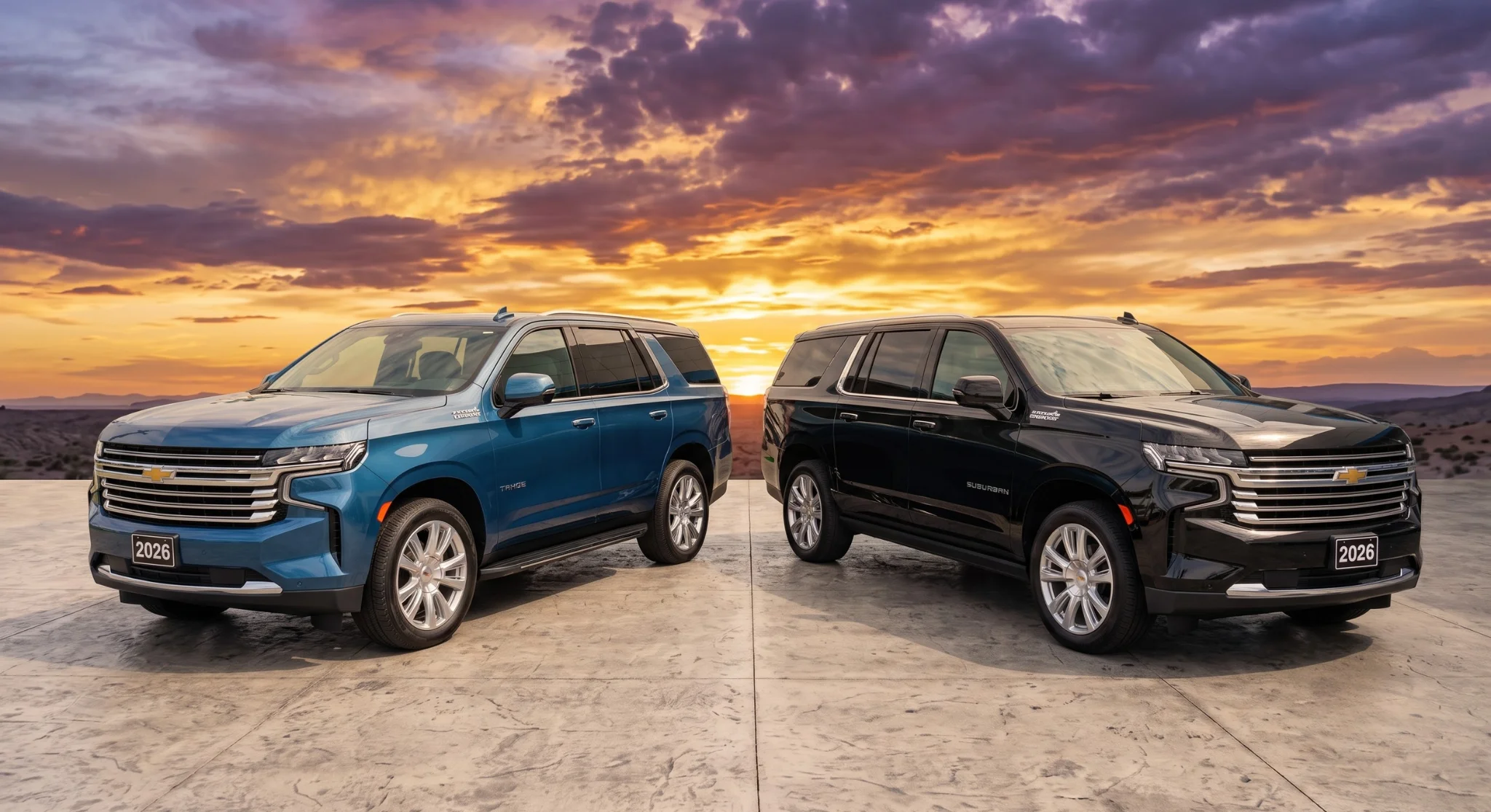
Deciding on the right full-size family SUV often comes down to two icons from the same showroom. The 2026 Chevy Tahoe and the 2026 Chevy Suburban share a platform, a powertrain lineup, and a trim ladder — yet they solve two different problems. This side-by-side breaks down exactly how they differ in passenger space, cargo capacity, performance, towing, technology, safety, and price, so you can pick the footprint that fits your household. At Riverside Chevrolet, we carry both, so the honest answer is: it depends on how much room you actually need.
The Short Version: Same DNA, Different Footprint
Both SUVs are built on GM’s full-size truck platform and are assembled in Arlington, Texas. They share engines, trims, technology, and nearly identical front-cabin dimensions. The single biggest difference is length — the Suburban is about 15 inches longer overall than the Tahoe — and that stretch translates directly into third-row legroom and cargo space behind the third row.
- Choose the Tahoe if you want a full-size SUV that’s easier to park, garage, and maneuver day to day.
- Choose the Suburban if you routinely carry a full house of passengers and their gear at the same time.
Everything below explains what those inches actually buy you.
2026 Tahoe vs. Suburban: Full Spec Comparison
Here’s the head-to-head that matters. The advantage column reflects which model leads that specific category — not which is the better vehicle overall.
| Specification | 2026 Chevy Tahoe | 2026 Chevy Suburban | Advantage |
|---|---|---|---|
| Overall length | 211.3 in | 226.3 in | Tahoe (nimbler) |
| Third-row legroom | 34.9 in | 36.7 in | Suburban |
| Cargo behind 3rd row | 25.5 cu ft | 41.5 cu ft | Suburban |
| Max cargo (rows folded) | 122.7 cu ft | 144.5 cu ft | Suburban |
| Max seating | Up to 9 | Up to 9 | Tie |
| Standard engine | 5.3L V8 (355 hp) | 5.3L V8 (355 hp) | Tie |
| Max towing (properly equipped) | 8,400 lbs | 8,200 lbs | Tahoe |
| Base MSRP (LS 2WD) | $63,495* | $66,495* | Tahoe (value) |
*Manufacturer’s Suggested Retail Price (MSRP) for new vehicles includes manufacturer and distributor options and delivery, process and handling fees, which may be subject to change at any time. MSRP excludes taxes, title, license and dealer installed options, accessories, fees and charges. MSRP is not the dealer advertised price. Dealer price will vary. The dealer sets the final price.
The Suburban holds roughly 63% more cargo behind the third row than the Tahoe (41.5 vs. 25.5 cu ft) — the difference between fitting a stroller and fitting a full family’s luggage without folding a seat.
Passenger and Cargo Space: Where the Length Goes
Step inside and the first two rows feel identical — both offer 44.5 inches of first-row legroom and 42.0 inches in the second row, with limousine-like comfort for adults on long drives. The divergence starts behind the second row.
The Tahoe’s third row is genuinely usable — its 34.9 inches of legroom comfortably seats teenagers and adults for short-to-medium trips, better than most three-row SUVs on the market. The Suburban’s third row adds 36.7 inches, and that extra 1.8 inches is the difference between “fine for a while” and “comfortable to the coast.”
Cargo is where the Suburban pulls decisively ahead:
- Behind the third row: Suburban 41.5 cu ft vs. Tahoe 25.5 cu ft. The Suburban swallows full-size luggage sets, coolers, and sports gear with all three rows occupied — no roof box required.
- Maximum, seats folded: Suburban 144.5 cu ft vs. Tahoe 122.7 cu ft. Both create a flat load floor; the Suburban simply offers a cavernous, best-in-class hauling bay.
If your third row is only used occasionally, the Tahoe’s folding seats deliver a huge, versatile cargo floor that handles bulk shopping and big-box runs with ease.
Performance, Engines, and Towing
Neither of these SUVs is cumbersome or underpowered — and they share the exact same engine lineup, each paired with a smooth 10-speed automatic transmission.
| Engine | Horsepower | Torque | Best For |
|---|---|---|---|
| 5.3L EcoTec3 V8 (standard) | 355 hp | 383 lb-ft | Everyday family value |
| 6.2L EcoTec3 V8 (available) | 420 hp | 460 lb-ft | Strongest acceleration & passing power |
| 3.0L Duramax Turbo-Diesel (available) | 305 hp | 495 lb-ft | Torque, towing & long-haul efficiency |
Driving Feel
Because the Tahoe is shorter and lighter, it feels a touch more responsive and is noticeably easier through tight turns and compact parking structures. The Suburban’s longer wheelbase makes it the more composed highway cruiser — the extra distance between the axles smooths out expansion joints and road imperfections. Both can be equipped with Magnetic Ride Control and Four-Corner Air Ride Adaptive Suspension for a premium, controlled ride.
Towing: A Common Surprise
Despite its size, the Suburban is not the stronger tow vehicle. When properly equipped, the Tahoe tows up to 8,400 lbs versus the Suburban’s 8,200 lbs. The Tahoe’s lower curb weight gives it the slight edge. It’s a modest 200-pound gap that won’t swing most decisions, but it’s worth knowing if you’re near the upper limit of either SUV’s capability.
Maximum towing and payload capacity figures are based on properly equipped vehicles and vary by configuration. Do not exceed any weight rating. See your owner’s manual and the vehicle’s door-jamb label for specific capacities.
Technology That Keeps Everyone Connected
Both cabins center on the same tech suite, so you’re not trading features for size:
- 17.7-inch diagonal touchscreen with Google Built-in — voice navigation, media, and hands-free help
- 11-inch digital driver display, customizable for navigation and vehicle data
- Wireless Apple CarPlay and Android Auto — standard
- Available rear-seat entertainment with screens mounted to the front headrests
- Multiple USB ports across all three rows
- Available Super Cruise hands-free driving on compatible highways (select trims)
Safety Systems Built for Everyday Driving
Both the Tahoe and Suburban come standard with Chevrolet Safety Assist, a suite of active driver-assistance features:
- Automatic Emergency Braking
- Front Pedestrian Braking
- Forward Collision Alert
- Lane Keep Assist with Lane Departure Warning
- Following Distance Indicator & IntelliBeam auto high beams
Beyond the standard suite, both offer available HD Surround Vision — a stitched overhead camera view that makes spotting low obstacles, bikes, and pedestrians in a full-size SUV far easier — plus advanced trailering camera packages with transparent-trailer views, tire-pressure monitoring, and length-aware blind-spot alerts.
Driver-assist and safety systems are supplemental aids and are not a substitute for safe, attentive driving. Their effectiveness depends on weather, road, and traffic conditions and other factors. Always obey traffic laws and stay attentive to the road. See your owner’s manual for system details and limitations.
Trims, Pricing, and Value
Both SUVs share the identical six-trim ladder, so you can match capability and luxury to your budget in either footprint.
| Trim | Character | 2026 Tahoe MSRP* | 2026 Suburban MSRP* |
|---|---|---|---|
| LS | Core family value, cloth seating | $63,495 | $66,495 |
| LT | Added comfort & convenience, leather | $66,495 | $69,495 |
| RST | Sporty, blacked-out exterior styling | $71,495 | $74,495 |
| Z71 | Standard 4WD, all-terrain tires, skid plates | $73,495 | $76,495 |
| Premier | Upscale materials & driver tech | $78,395 | $81,395 |
| High Country | Flagship luxury; 6.2L V8 standard | $81,995 | $86,495 |
*Starting MSRP with rear-wheel drive, per Chevrolet. The Suburban commands roughly a $3,000 premium over the equivalent Tahoe trim on most matching trims, reflecting its larger body.
Manufacturer’s Suggested Retail Price (MSRP) for new vehicles includes manufacturer and distributor options and delivery, process and handling fees, which may be subject to change at any time. MSRP excludes taxes, title, license and dealer installed options, accessories, fees and charges. MSRP is not the dealer advertised price. Dealer price will vary. The dealer sets the final price.
For buyers who prioritize maximum cargo above all else, the Suburban’s premium is easy to justify. For those who don’t need that extra hold behind the third row, choosing the Tahoe frees up that budget for a higher trim or desirable option packages.
Which One Should You Buy?
Both are excellent — the decision is honestly about footprint, not quality.
Choose the 2026 Tahoe if…
- You want easier parking and garaging
- You value a slightly more nimble drive
- You want the higher max tow rating (8,400 lbs)
- You’d rather put budget toward a higher trim
Choose the 2026 Suburban if…
- You regularly seat adults in the third row
- You haul luggage and passengers together
- You want maximum, best-in-class cargo room
- You refuse to compromise on space
The 2026 Chevy Tahoe is the versatile, garage-friendly daily driver for active families. The 2026 Chevy Suburban is the space champion for households that never want to choose between people and gear. The best way to decide is to sit in the third row of each and drive them back to back — our team at Riverside Chevrolet, serving Riverside, San Bernardino, Fontana, Ontario, Corona, and Eastvale, will set you up with both. For more model breakdowns, explore our Chevy research hub.
Frequently Asked Questions
Is the Tahoe easier to park and garage than the Suburban?
Yes. The Tahoe is about 15 inches shorter overall (211.3 in vs. 226.3 in), making it noticeably easier to fit in standard garages and tight parking spaces.
Does the Suburban offer more third-row legroom?
Yes. The first two rows are identical, but the Suburban provides 36.7 inches of third-row legroom versus the Tahoe’s 34.9 inches — the better choice for carrying adults in the back on longer drives.
Which model is better for towing a trailer or boat?
The Tahoe, slightly. When properly equipped, it tows up to 8,400 lbs versus the Suburban’s 8,200 lbs, thanks to its lighter curb weight. Both share the same engine lineup, so it’s a marginal difference.
How much more does the Suburban cost than the Tahoe?
About $3,000 more at the base level (LS 2WD: $66,495 vs. $63,495 MSRP), and the Suburban holds roughly that same premium across most matching trims, reflecting its larger body.
Disclaimers
Pricing: Manufacturer’s Suggested Retail Price (MSRP) for new vehicles includes manufacturer and distributor options and delivery, process and handling fees, which may be subject to change at any time. MSRP excludes taxes, title, license and dealer installed options, accessories, fees and charges. MSRP is not the dealer advertised price. Dealer price will vary. The dealer sets the final price.
Towing & payload: Maximum towing and payload capacity figures are based on properly equipped vehicles and vary by configuration. Do not exceed any weight rating. See your owner’s manual and the vehicle’s door-jamb label for specific capacities.
Driver-assist & safety systems: Driver-assist and safety systems are supplemental aids and are not a substitute for safe, attentive driving. Their effectiveness depends on weather, road, and traffic conditions and other factors. Always obey traffic laws and stay attentive to the road. See your owner’s manual for system details and limitations.